
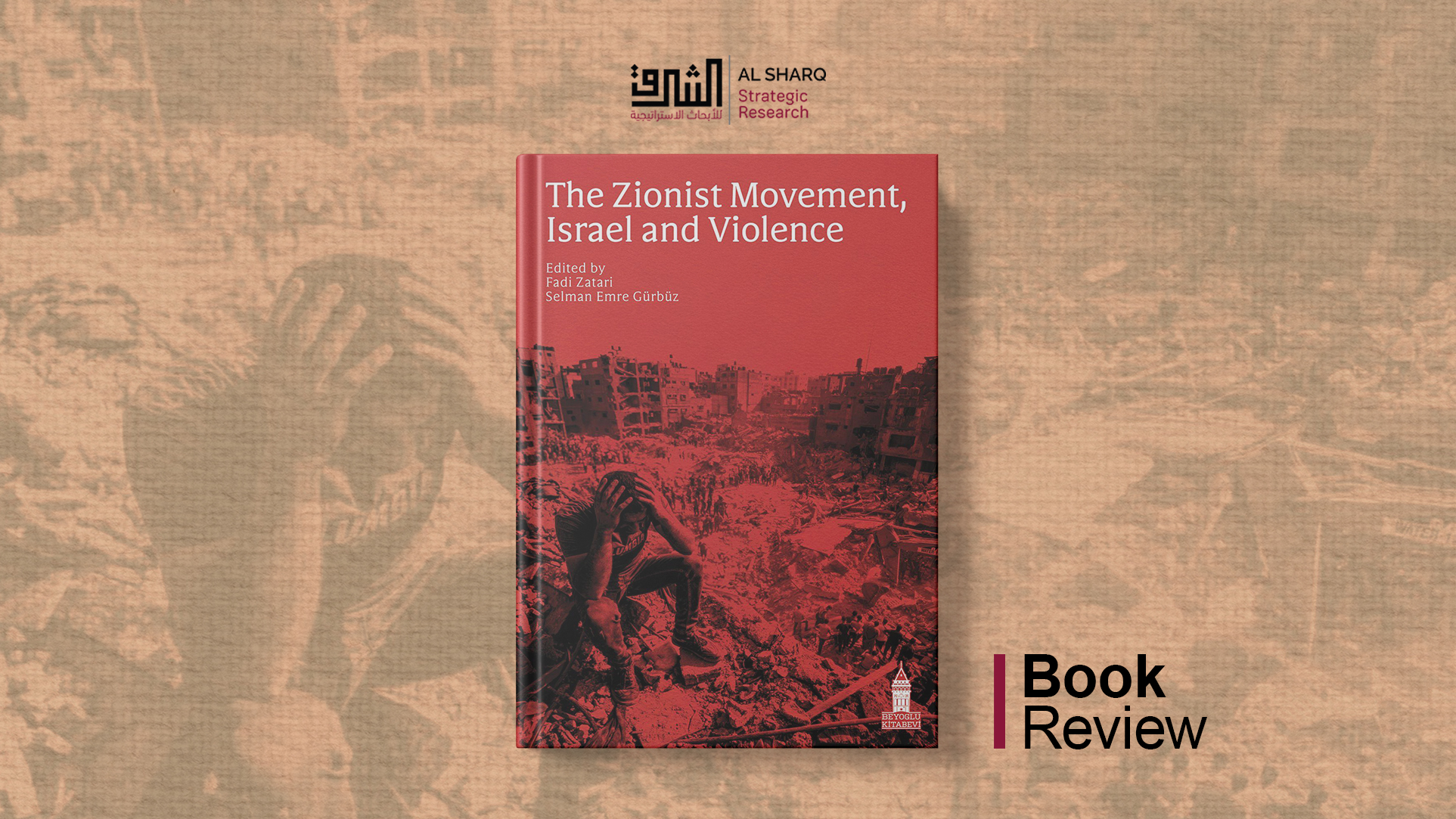
 Taqwa Nedal Abu Kmeil
Edited by
Fadi Zatari
Selman Emre Gürbüz
Introduction
This volume offers a comprehensive and analytically cohesive interrogation of Zionism as a political project, situating it within the broader frameworks of settler colonialism, imperial modernity, racial governance, and global power hierarchies. Across its six chapters, the book advances a central thesis: Zionism must be understood not as an isolated nationalist movement or a tragic byproduct of European antisemitism, but as a structural formation embedded in colonial logics, sustained through legal regimes, institutional practices, epistemic production, and organized violence. Rather than treating the question of Palestine as a localized territorial dispute, the contributors situate it within global processes of modern state formation, racial capitalism, international law, and the politics of knowledge.
Collectively, the chapters move from theoretical grounding to historical analysis and normative prescription. They examine Zionism’s relationship to colonial modernity; interrogate the silences of postcolonial and decolonial scholarship; deconstruct dominant Zionist narratives; analyze the legal architecture of occupation, apartheid, and genocide; and ultimately articulate strategic pathways toward structural transformation. The book’s methodological range—drawing from International Relations theory, postcolonial studies, legal scholarship, and historical research—servers a unified objective: to challenge the normalization of Zionist domination in academic, political, and media discourse, and to re-center the Palestinian question within debates on decolonization and global justice.
The introduction to The Zionist Movement, Israel and Violence, written by Selman Emre Gürbüz, sets the intellectual and ethical tone for a volume that seeks to interrogate Zionism through both theoretical and practical lenses. From the outset, the book positions Zionism not merely as a political movement or state ideology, but as a structure sustained through multiple forms of violence__physical, discursive, epistemic, and institutional. Gürbüz frames the project as a response to what he describes as an ongoing colonial present, where Zionist practices extend beyond territorial domination into the realm of global knowledge production and legitimacy-building.
The book is structured into two interconnected parts: theoretical analyses and practical examinations. This structure reflects Gürbüz’s insistence that theory without practice remains abstract, while practice without theory lacks a coherent analytical framework. The introduction carefully maps out each chapter, presenting the volume as a cumulative intellectual effort aimed at what the editor terms a “decolonial praxis.” In this regard, the book situates itself within contemporary dabates on settler colonialism, genocide studies, international law, and critical International Relations (IR) theory.
The theoretical section includes historical, ontological, and epistemological critiques of Zionism Berdal Aral’s contribution situates Zionist violence within a historical continuum, while Quraysha Ismail Sooliman draws parallels between Zionism and other settler-colonial projects. Fadi Zatari problematizes the concept of terrorism the Zionist context, arguing that the discourse itself is strategically manipulated. Omar Fili introduces the notion of “the politics” highlighting the entanglement of theology and secular nationalism in Zionist ideology. Finally, Gürbüz’s own chapter critiques postcolonial IR scholarship for what he describes as the marginalization__or “colonial erasure”__of Palestine within knowledge production.
The second half of the volume shifts toward practical manifestations of violence, including military doctrine (such as the Dahiya Doctrine), media narratives following October 7, 2023, and international legal frameworks addressing alleged violations. Particularly noteworthy is the emphasis on discourse analysis and “scholasticide” a term used to describe the silencing of academic voices. The book concludes with Sami AL-Arian’s chapter, which anchors the discussion in international law and proposes concrete forms of transnational activism.
Berdal Aral’s chapter delivers a forceful and historically grounded exposition of Zionist violence as a structural and enduring feature of the Zionist project. Rather than portraying violence as episodic or reactive, Aral convincingly demonstrates that it has functioned as a foundational instrument in the establishment, consolidation, and expansion of the Israeli settler-colonial state.
From its ideological origins in nineteenth-century European nationalism and colonial modernity, Zionism is situated as a movement that fused ethnoreligious nationalism with territorial exclusivity. Aral persuasively argues that the dispossession of Palestinians was not an unfortunate byproduct of state formation but a deliberate and programmatic objective embedded in early Zionist planning. By revisiting pivotal moments such as plan Dalet, the Nakba of 1948, and subsequent military operations, the chapter underscores a clear historical continuity: violence has been central to securing demographic transformation and territorial control.
A key strength of the chapter lies in its layered typology of violence. Aral moves beyond battlefield events to examine psychological normalization of militarism, systemic impunity, and the internalization of force as a civilizational necessity within Zionist political culture. This analysis powerfully illustrates how settler colonialism reshapes not only geography but also consciousness. Violence becomes routinized, legitimized, and socially reproduced. The chapter also situates Zionist violence within broader geopolitical structures, particularly the enabling role of Western imperial powers. By connecting Israeli practices to global militarization and post-9/11 security paradigms, Aral highlights how Palestine has functioned as both laboratory and precedent within international systems of coercion.
Overall, Aral’s contribution anchors the volume historically and morally. It establishes the argument that Zionist violence is not incidental deviation but structural imperative__an argument that resonates throughout the book’s subsequent theoretical and practical chapters.
Quraysha Islmail Sooliman’s chapter offers one of the most conceptually expansive and theoretically sophisticated analyses in the volume. By situating Zionism squarely within the global framework of settler colonialism, Sooliman demonstrates that Palestinian dispossession is part of a broader historical pattern in which Indigenous populations are displaced, erased, and replaced in the service of settler sovereignty.
Drawing on Patrick Wolfe’s formulation of settler colonialism as a structure rather than an event, the chapter clarifies that elimination operates not only through mass expulsions such as the Nakba, but through ongoing processes of fragmentation, legal discrimination, spatial reengineering, and epistemic erasure. Violence is presented as multidimensional—physical, structural, cultural, spatial, and discursive—each layer reinforcing the others in a totalizing system of domination.
Particularly compelling is Sooliman’s treatment of spatial violence. By invoking concepts such as “spatial genocide” and the colonial cartographic imagination, the chapter reveals how land, borders, mapping technologies, and infrastructural design function as instruments of dispossession. Geography itself becomes weaponized. Gaza’s siege, West Bank fragmentation, and settlement expansion are not administrative policies but spatial manifestations of a settler-colonial logic of replacement.
Equally powerful is the chapter’s engagement with epistemic and discursive violence. Through analysis of hasbara, media framing, educational suppression, and legal restrictions on Nakba commemoration, Sooliman shows how narrative control operates alongside physical coercion. The struggle over language and coercion. The struggle over language and memory is inseparable from the struggle over land and sovereignty. By integrating Fanon’s insights on colonial dehumanization and cathartic resistance, the chapter deepens the psychological and existential dimensions of Palestinian resistance
What makes this chapter especially significant is its insistence that Palestine cannot be understood in isolation. The structural parallels with other settler-colonial states – United States, Canada, Australia, South Africa – expose global continuities of racialized sovereignty. The Palestinian struggle thus emerges as a central site of contemporary decolonial praxis.
Fadi Zatari’s chapter offers a sharp conceptual intervention into the politics of language and legitimacy by interrogating the deployment of “terrorism” within Zionist discourse. Rather than treating terrorism as a neutral legal or analytical category, Zatari arguses that it operates as a strategic discursive instrument used to criminalize Palestinian resistance while simultaneously legitimizing Israeli state violence. In this framing, the language of counterterrorism becomes a mechanism through which power is normalized and asymmetries are obscured.
Drawing on discourse analysis and social constructivist approaches. Zatari demonstrates that “terrorism” is not merely descriptive but constitutive: it produces political realities. By constructing Palestinians as terrorists, the discourse removes them from the realm of legitimate justification of collective punishment, military escalation, and infrastructural destruction under the rhetorical umbrella of “self-defense”.
Importantly, the chapter expands the analytical field of terrorism studies by foregrounding the question of state terror. Zatari argues that the definitional element commonly associated with terrorism – political objectives, fear generation, targeting of civilians – cannot be restricted to non – state actors when states possess vastly greater destructive capacities. By applying this lens to Gaza, he contends that large-scale military campaigns framed as counterterrorism operations must be scrutinized as potential forms of organized state violence.
The chapter further situates this discursive strategy within a settler-colonial structure. Drawing on concepts such as the “logic of elimination” and the “logic of dehumanization” Zatari shows that labeling Palestinians as terrorists is not incidental rhetoric but a necessary ideological component of a system that requires the denial of Palestinian political existence. In this sense, the terrorism label functions as a gatekeeping category that regulates whose suffering is visible and whose violence is intelligible within international discourse.
Particularly notable is Zatari’s analysis of narrative analogies – such as comparisons between Hamas and ISIS – which position Israel within a broader civilizational struggle against “Islamic terror”. such framing, he argues, activates post – 9/11 security paradigms and embed the Palestinian question within Western counterterrorism imaginaries, thereby insulating Israeli actions from scrutiny.
Fili’s most distinctive intervention is his insistence that Zionist rhetoric and practice cannot be fully captured by labels like “fascism” or “colonialism” alone – even though both are relevant – because Zionism draws power from a deeper fusion of modern secular statehood with older theological imaginaries. He calls this fusion “the politics”: the conversion of national projects into quasi – religious missions, where history becomes destiny, politics becomes salvation and military force becomes purification.
This matters because it explains why Zionist violence repeatedly appears as morally untouchable in its own self-understanding and in western political culture: it is shielded by an implicit sacred grammar. In Fili’s framing, Israel does not merely claim security, it claims redemption. It does not only seek state interest, it seeks an “end of history” scenario in which sovereignty becomes the final moral settlement of the world.
Rather than treating Zionism as an isolated “Jewish” phenomenon, Fili places it firmly within post-Enlightenment European modernity – and this is one of the chapter’s strongest decolonial moves. By drawing on debates around secularization and political theology (including Schmitt) he shows how modern ideologies can inherit theological structures even when they speak the language of reason, progress and civilization.
He links this to nationalism and liberal modernity as systems that sacralize “the people” produce the modern citizen and intensify in-group/out-group boundaries into existential conflicts. This helps the reader understand how Zionism as a modern European project could mobilize religious symbolism not as mere ornament, But as the emotional and metaphysical fuel of settler-colonial expansion.
The chapter is the argument that modern nationalism is inseparable from racial imagination – an imagination that in Fili’s reading is itself tied to theological patterns of purity, choosiness and telegony. By invoking frameworks that treat race as deeply embedded in Western
Civilizational self-construction, Fili positions Zionism as part of a broader Western structure that divides humanity into those “inside” progress and those cast as obstacles to it.
This section is especially valuable for the book’s anti-colonial arc because it makes visible a core mechanism of Zionist violence: the conversion of Palestinians into an ontological problem not simply a political dispute. Once the nation is sacralized, the Indigenous population is not merely a rival, it becomes an anathema to the “holy” project of the state.
Fili’s use of Abdelwahab El-Messiri is more than citation; it functions as an interpretive key. The argument that Zionism shifts “holiness” from god and law to the people-as-absolute is crucial, it explains how a modern ethno-state can justify extreme violence while presenting itself as moral
necessity. In this reading “Jewishness” is reconstituted in nationalist terms into an immanent sacred identity and the state becomes the instrument through which this sanctity is realized.
Fili’s discussion of the transformation of “victimhood” into political immunity is one of the chapter’s most compelling contributions. Using Rabinovich and Zetral via Moshe Dayan, he shows how the holocaust becomes a central moral reference point that is repeatedly mobilized to sacralize militarization and normalize perpetual war. The Israeli citizen is constructed as a soldier not simply by security conditions, but by a national theology of “never again” that is re-scripted into pre-emptive domination.
In the 7th chapter Shady Ibrahim examines what it identifies as a decisive transformation in Israeli military doctrine, arguing that the Dahiya Doctrine represents not a battlefield improvisation but an institutionalized method of warfare rooted in political choice. The chapter’s central claim is clear: the doctrine is not a military necessity imposed by asymmetric threats, but a deliberate strategy of coercion that normalizes disproportionate force, infrastructural destruction, and collective punishment as instruments of deterrence.
From the outset, the chapter challenges the long-standing Israeli narrative of “defensive doctrine” By tracing the evolution from the Ben-Gurion era’s deterrence-early warning-decisive victory triad to the contemporary operational logic of Dahiya, the author demonstrates how the language of defense has increasingly masked a structurally offensive practice. The paradox that Israel defines itself as a “defense force” while repeatedly employing overwhelming force beyond its borders is not treated as a contradiction, but as a constitutive feature of its doctrine.
One of the chapter’s strongest contributions lies in its insistence that Dahiya is not reducible to a single episode in southern Lebanon in 2006. Rather, it argues that what began as an operational pattern in Beirut’s Dahiya district became a repeatable model. Through statements by senior Israeli commanders, policy publications, and subsequent campaign patterns in Gaza (2008,2012,2014,2021,and 2023) the chapter builds the case that Dahiya functions as doctrine in practice—even when not formally codified as such in official documents.
The discussion of deterrence is particularly significant. Instead of treating deterrence as a neutral strategic concept, the chapter reveals how it operates in this context as
deterrence-through-destruction. Civilian infrastructure—housing, electricity grids, water networks, schools, and hospitals—becomes embedded within the logic of military pressure. The repeated destruction of life-sustaining systems is thus not incidental collateral damage, but part of a coercive design aimed at disciplining the broader social environment from which resistance movements emerge.
In her chapter Sundus Aladra argues that the Israeli state narrative after October 7 , 2023 relied heavily on instrumental fabrication emotionally charged allegations circulated rapidly through media and political channels , gaining legitimacy before evidentiary standards were met , and then functioning as moral cover for a prolonged publicly visible campaign of mass violence in Gaza.
That chapter’s title captures its core thesis: the accusations amplified against Palestinians, often Palestinians during the assault on Gaza, while also diverting scrutiny from those practices .
The chapter is its framing of “knowledge production” as a battlefield. It positions mainstream journalism and academia not as neutral observers, but as institutions with agenda-setting power that can normalize violence by validating certain claims, ignoring others, and shaping which victims are treated as “worthy” of attention. By drawing on Herman and Chomsky’s Manufacturing Consent, the chapter provides a theoretical lens to interpret why horrific allegations —when aligned with dominant geopolitical narratives — can spread with minimal verification while well-documented suffering is downplayed or treated as background noise The chapter proceeds through three emblematic claims repeatedly used to justify Israeli actions:
(1)the decapitation of infants, (2) systematic rape , and (3) the use of hospitals for military purposes . Its approach is essentially evidentiary and discursive at once : it tracks how claims enter public discourse , how they are repeated by authoritative platforms , and how later retractions or contradictions fail to undo the original narrative effect.
The chapter concludes with an ethically charged, politically explicit claim: Israel’s fabrication strategy thrives in an ecosystem where journalism amplifies early allegations with minimal verification and academia avoids direct confrontation with power. In this environment, retractions do not undo the narrative architecture already built, and the victim is repeatedly
reframed as perpetrator to justify escalatory violence. The chapter calls–implicitly and explicitly–for a higher evidentiary standard, a decolonial commitment that moves beyond theory, and an institutional refusal to let atrocity be laundered through discourse.
Chapter 9 functions as the normative and strategic culmination of the volume. While previous chapters analyze Zionist violence historically, discursively, militarily, and institutionally, this chapter moves decisively from diagnosis to prescription. Its central claim is clear and uncompromising: Zionism is not a national liberation movement but a settler-colonial project, and therefore justice in Palestine requires dismantling the structures that sustain it—not merely reforming or managing them.
The chapter opens by challenging Zionism’s foundational self-description as a movement of Jewish national liberation. Instead of engaging that claim rhetorically, the author subjects it to two external standards: settler-colonial theory and international law.
By invoking Patrick Wolfe’s formulation – “settler colonialism is a structure, not an event”- the chapter places Palestine within a comparative framework that includes other settler projects. This is one of its strongest analytical moves. It shifts the discussion from episodic violence (wars, parallel institutions and the gradual elimination of the indigenous population as a political subject.
The argument gains additional weight through its grounding in international law. By citing UNGA Resolutions 1514 and 2625, the right of return (Resolution 194) and subsequent affirmations of Palestinian self-determination, the chapter demonstrates that anti-colonial self-determination requires ending alien domination – not replacing one hierarchy with another. In this sense, the chapter reframes the debate: the question is not whether Zionism calls itself liberation, but whether its institutional outcomes meet legal standards of equality and self-determination. The author’s answer is unequivocal -they do not.
A significant strength of the chapter lies in its reliance on cumulative legal and institutional findings rather than rhetorical accusation. The ICJ’s 2004 Wall Advisory Opinion, UNSC Resolution 2334 and reports by B’Tselem, Human Rights Watch and Amnesty International are marshaled to argue that the governing structure between the river and the sea amounts to apartheid under international law.
This legal layering is strategically important. It situates the critique of Zionism not as ideological opposition, but as alignment with international jurisprudence. The chapter insists that apartheid and genocide are not metaphors but legal categories tied to specific institutional practices: separate legal systems, land confiscation, denial of return, demographic engineering and structural domination.
By grounding the argument in the Rome Statue and the Apartheid Convention, the chapter strengthens its claim that dismantlement is not a radical aspiration but a legal necessity.
The second major section systematically addresses fifteen dominant Zionist myths. This part of the chapter serves both pedagogical and strategic purposes: it equips readers with concise counter-arguments rooted in historical record and demographic data.
Among the most analytically significant myth critiques:
“A land without a people” is countered with Mandate census data and village documentation, demonstrating pre 1948 demographic realities.
“Gaza is not occupied” is rebutted through the doctrine of effective control in international humanitarian law.
“Oslo was a genuine peace process” is reframed as a mechanism that entrenched asymmetry and settlement expansion.
This myth-by-myth structure is rhetorically forceful and accessible. It may not provide exhaustive historiography for each claim, but its function is strategic to destabilize the narrative infrastructure that legitimizes Zionist governance.
Crucially, the chapter emphasizes that dismantlement is not abstract rhetoric but a policy sequence. It outlines legal pathways (universal jurisdiction, ICC processes), economic levers (divestment, sanctions), cultural and academic pressure (guided by PACBI principles) and grassroots mobilization.
One of the chapter’s most distinctive contributions is the articulation of twelve “strategic imperatives” underpinning Zionist continuity: exclusivism, exclusion, expansion, military
doctrine, unclear monopoly, great-power patronage, regional fragmentation and more. This framework shifts analysis from morality to mechanics. It invites activists and policymakers to study how Zionist dominance is reproduced institutionally and geopolitically and to target those nodes strategically.
The conclusion articulates a future grounded in equality, return and decolonization. It argues that dismantling Zionist supremacy would not only restore Palestinian rights but also liberate Judaism from political instrumentalization.
On the End
The Zionist Movement, Israel and Violence stands as a theoretically ambitious and politically engaged contribution to contemporary debates on settler colonialism, decolonization and global power. Its greatest strength lies in its structural framing of Zionism – not as an episodic or reactive phenomenon, but as an enduring formation sustained through physical, discursive, legal, epistemic and spatial forms of violence. By bridging historical analysis, international relations theory, political theology discourse analysis and international law, the volume succeeds in situating the Palestinian question within broader global dynamics of modernity, racial governance and imperial power.
A limitation concerns the range of sources and perspectives engaged in the volume. Many of the references cited belong to scholars who already operate within a critical or anti-Zionist intellectual tradition. Although these contributions are important and valuable, the absence of engagement with a broader spectrum of historiography—particularly debates among Israeli historians and other scholars of Zionism—reduces the analytical pluralism of the book. Engaging with contrasting interpretations, even in order to refute them, would likely have strengthened the credibility and persuasiveness of the overall argument.
Another point that deserves attention is the tendency in some chapters to portray Israeli society as relatively homogeneous in its political attitudes and ideological orientation. In reality, Israeli society has long been characterized by significant internal divisions regarding. By downplaying these internal debates, the analysis sometimes risks presenting a simplified image of a complex
political landscape. A more nuanced treatment of these internal dynamics could have enriched the book’s explanatory power and avoided the impression of analytical overgeneralization.