 Omair Anas
The joint US-Israel war on Iran predictably initiated without regional consultation or support from the NATO allies in Europe. The war might have started with the assumption that knocking out the top Iranian leaders would quickly embolden anti-regime forces within Iran, expediting regime change. The main objectives of denuclearization of Iran and destroying Iran’s ballistic missile program would have been easily achieved with anti-regime forces in control of the streets. After a month of massive bombing and airstrikes, the elimination of top leaders has not shown any sign of regime change or loss of control. Contrary to assumptions, the remaining command of Iran’s Revolutionary Guard has stepped up its military response against hitting Israeli targets deep inside Israeli cities and American bases all over the Gulf region. It is now clear that the United States and Israel received no formal support from their allies in Europe or the Middle East, other than acquiescent silence, even if the shock and awe strategy had been successful. With the first scenario having gone unsuccessful, the United States, not Israel, is facing pressure from its allies in Asia, Europe, and the Middle East as the oil prices have shot up and uncertainties loom large over future supply after Iran has started choking the traffic in Hormuz. Aware of the Iranian response in such a scenario, the Gulf states patiently intercept Iranian drones and missiles directed at American targets. As the war prolongs with no signs of achieving any of the declared objectives, the Gulf states find themselves more vulnerable and helpless. Unlike previous regional wars in Iraq, Syria, and Afghanistan, for example, the war on Iran has been fully planned to be a unilateral war jointly waged by Israel and the United States. Not just the Gulf allies, the main stakeholders of the conflict, but also NATO member Türkiye were kept outside the consultation before launching the war. This disregard of the interests of Gulf states and regional security has questioned the GCC-US relations and the Trump administration’s efforts to normalize relations with Israel.
Over the past eight decades of the United Nations-led global order, most Islamic nations have been subjected to the consequences. Afghanistan, Iraq, Syria, and Palestine have faced the brunt of Western warfare and civil war that resulted from their failures. Somalia, Sudan, and Libya have gone through devastating internal conflicts, and Algeria has not yet fully recovered from the civil war of the 1990s. Pakistan has also been at the center of Afghanistan’s civil war and has been accusing the United States of using Pakistan for its Afghan war and leaving behind an unstable Afghanistan.[i] International institutions have been unfair to Muslim nations and have been unable to prevent external interventions. The prolonged suffering of Muslim nations has weakened them to the point that they have lost any diplomatic or strategic influence in their own conflicts, including in Gaza, Afghanistan, or Syria.
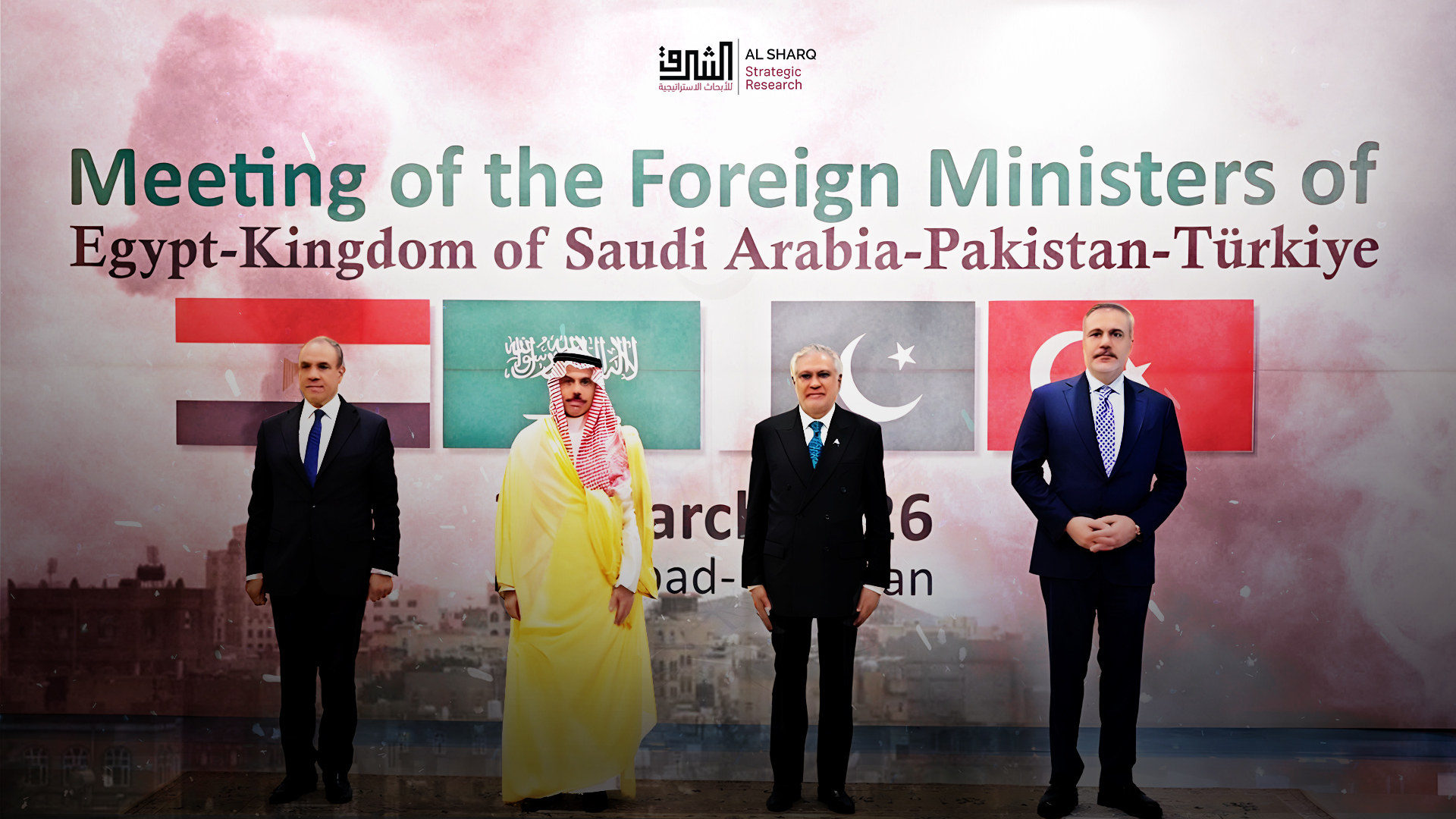
In an unusual turn of events, Islamabad has emerged as a favorable interlocutor for American-Iranian talks to end the war, which many experts now believe is heading toward a stalemate. As of now, the indirect dialogue mediated by Pakistan and joined by Saudi Arabia, Egypt, and Türkiye has gone well and might help the resumption of indirect dialogue between Iran and the United States. If these meetings of four Muslim nations, now called STEP, succeed in brokering peace between Iran and the United States, a third bloc in world politics might rise to fill the gap left by a reluctant global south and divided West.
The response of the Global South to the three-year-long Gaza crisis was a stark reminder to the Middle East that the countries of the Global South, China, India, and Russia, have only limited influence when it comes to the biggest humanitarian tragedy imposed by the state of Israel. They remained silent about offering any platform or initiative for conflict resolution. India, China, and Russia hold significant leverage over Israel with a high volume of military and trade relations, but the Gaza ceasefire was brokered mostly by Western and Islamic capitals. As a result, the West, led by the Trump administration, has re-established itself as a principal player in the Arab-Israeli conflict. The Iran-Israel war opened an even harsher reality: that India, once treated Iran as a strategic partner, did not even bother to condemn the assassination of its supreme leader, Ayatollah Khamenei. Russia might be excused as being occupied in the Ukraine war, but Iran-Russia military intervention to save Bashar al-Assad has deepened extraordinary strategic cooperation to the extent that Iran has also supplied its Shahed drones to Russia during the Ukraine war. To say that Putin has no personal influence on Netanyahu would be an understatement. During the entire Syrian crisis, Russia was the most important channel to keep Israeli security assured. While the Syrian opposition was crushed, Russian air defense had rarely stopped hundreds of Israeli airstrikes on Syria during Assad’s rule.[ii] It might be premature to predict the decline of the Global South; however, in these two conflicts, its conspicuous absence had implications.
The Gaza war has become the most serious warning that the Arab world is at its weakest point and close to losing its ability to protect its territorial integrity and sovereignty. Lebanon is a failed state that has already lost its sovereignty,[iii] and Syria is being pushed in the same direction.[iv] Without US coordination and support, Egypt and Jordan are also vulnerable, even though they maintain diplomatic relations with Israel. The Gaza war has come as a warning that Israel’s vision of regional security and stability is in complete contradiction to that of the region. A more worrisome fact is that both the United States and Europe have no interest or intention in stopping Israel from destabilizing the entire region. The region is left alone to face Israel’s irredentist ambitions.[v] As the US’s dependency on Gulf oil declined and the US started withdrawing from the region, its role as a fair facilitator of peace talks between Israel and the Arabs gradually changed into a biased mediator.
The Abraham Accords have become another indicator for most Arab nations that the accords’ primary goal is to normalize Israeli occupation and kill remaining prospects for an independent and viable Palestinian state. The accord is considered a replacement for the two-state solution that several UNSC resolutions have approved. The Abraham Accord could be the worst option that Palestine might be ready to accept; however, even this option does not give any guarantee that Israeli expansion into Lebanon, Syria, Egypt, and Jordan will completely halt. It is gradually becoming known to the region that Israel’s expansionist ambitions, not Iran, are the biggest problem for regional peace and stability.[vi]
The regional security architecture that has prevented a conflict between Israel and the Arab world has heavily depended on US assurances and military support. However, expanding Israeli occupation of Palestine, Lebanon, and new settlements has proved them wrong, forcing Saudi Arabia to seek peaceful relations with Iran in a successful mediation brokered by China in 2023.[vii] The Israeli airstrike on Qatar in June 2025 was shocking even for Israel’s closest allies, the United States and Europe. A panicked Saudi Arabia rushed to sign a defense agreement with Pakistan with specific clauses to respond unitedly to any aggression on Saudi Arabia or Pakistan. Since the countries of the global south have little interest in the security and defense of Islamic countries, the new regional security architecture must have the tacit backing of the United States. The Gaza diplomacy by key Arab countries and the active participation of Pakistan and Türkiye in Trump’s Gaza Peace Board have helped the STEP countries build trust and confidence with the Trump administration. All four members have been strong supporters of the creation of a state of Palestine within the framework of UNSC resolutions.
STEP countries’ latest assignment, to broker peace between Iran and the United States, is more than a mediation effort. Three STEP countries are immediate neighbors of Iran, with Pakistan and Türkiye having historical ties. A prolonged conflict in Iran directly implicates their security, energy security, and sectarian order. Iran was part of the Baghdad Pact, along with Pakistan and Türkiye, until 1979, and its post-Islamic-revolution relations remained mostly unaffected. However, Saudi Arabia and Egypt had a rough patch thanks to Iran’s revolutionary export. This makes STEP an extraordinary player vis-à-vis Iran’s security and stability. If regime changes, that will also make Turkish and Pakistani foreign policy more complicated, as the new regime, apparently led by former royalists, might seek quick and unconditional relations with Israel, disregarding the interests of the Arab world, and can also emerge as a more favorable destination for Western investments and strategic relations. This could deepen sectarian division within the Islamic world. All four countries agree that Iran must not descend into chaos, and Iran must also not seek nuclear weapons. Their diplomacy focuses on saving Iran from chaos and assuring the West on nuclear weapons. In return, Iran needs a set of guarantees that both Pakistan and Türkiye, as trusted partners of the West, can offer. STEP assumes an ideal role of a regional group that is deeply invested in Western security architecture and assumes the leadership of the Islamic world, the biggest after the Christian world. For the Trump administration, the STEP countries offer a unique opportunity. With their successful engagement on the Gaza ceasefire, STEP represents the strongest bloc within the Islamic world whose recognition and engagement with Israel might end Israel’s perpetual insecurity and get recognition from most Islamic countries if Israel and STEP nations agree on a peace mechanism for Palestine.
Interestingly, STEP countries are favored by most Western nations, particularly the United States, as an apparent sign that the bloc does not aim to become an anti-West ideological bloc, something that has strained relations between Islamic and Western nations for a long time. This shift of Muslim nations to Western, or more precisely, the American security umbrella, has come in the context of when both Russia and China have also behaved pragmatically against the United States. The Shanghai Cooperation Organization, as well as BRICS, have softened their anti-American and anti-Western rhetoric to the extent that BRICS has not yet issued any condemnation of the Israeli attack on Iran.
Israel’s war on Gaza and Iran may be the primary catalysts of increasing cooperation and coordination within STEP nations; their economic and defense cooperation has started deepening since Türkiye sought rapprochement with Egypt and Saudi Arabia in 2021. Over the last few years, Pakistan has lost much influence in the Middle East amid India’s deepening relations with the Gulf states. While India has strong economic incentives for the Gulf states, Pakistan offered mostly defense and strategic depth to the Gulf region’s fragile security. The Gulf nations seek to reconcile Indian and Pakistani interests for their benefit.[viii] STEP countries’ successful diplomacy on Gaza and now helping dialogue with Iran aims at bringing the United States back to regional security in a way that the US stays in the role of fair facilitator of stability and peace without taking a side.
References
[i]https://theprint.in/world/pakistan-treated-worse-than-toilet-paper-khawaja-asif-calls-post-1999-us-alliance-a-historic-error/2851883/
[ii] https://thearabweekly.com/when-israel-bombs-syria-russia-turns-blind-eye#:~:text=That%20night%2C%20neither%20Russia’s%20S,own%20weapons%20on%20December%2028?
[iii] https://www.middleeasteye.net/news/netanyahu-orders-army-seize-more-land-lebanon-expand-buffer-zone#:~:text=war%20on%20Lebanon-,Netanyahu%20says%20Israel%20to%20seize,lands%20and%20expand%20’buffer%20zone’&text=Israeli%20Prime%20Minister%20Benjamin%20Netanyahu,Iran%20and%20its%20regional%20allies.
[iv] https://www.aa.com.tr/en/middle-east/netanyahu-issues-policy-to-demilitarize-southern-syria-vows-to-protect-druze-/3634466
[v] https://www.gov.il/en/pages/statement-by-pm-netanyahu-7-mar-2026
[vi] https://www.youtube.com/shorts/uhDm9smFlls
[vii] https://gjia.georgetown.edu/2023/06/23/saudi-iran-deal-a-test-case-of-chinas-role-as-an-international-mediator/#:~:text=Nevertheless%2C%20China’s%20interest%20in%20brokering,Bahrain%20between%202005%20and%202021.
[viii] https://www.isas.nus.edu.sg/wp-content/uploads/2019/04/ISAS-Insights-No.-558.pdf