
 Javad Heiran-Nia
With the outbreak of the 2026 February war and the U.S. and Israeli strikes on Iranian territory—which resulted in the killing of Ayatollah Ali Khamenei, Iran’s Supreme Leader, several senior military commanders, and the targeting of military and missile facilities—Iran initially responded not only by attacking Israel but also by striking U.S. bases and assets in the Arab states in the Gulf.
These attacks differed significantly in both the number of countries targeted and the scope of objectives compared with Iran’s retaliatory strike during the 12-day war of 2025 following the U.S. attack on nuclear facilities in Isfahan, Natanz, and Fordow.
In the recent conflict, U.S. bases and assets across all member states of the Gulf Cooperation Council—including countries friendly to Iran such as Qatar and Oman—were targeted. Moreover, the scope of these strikes was not limited to U.S. military installations; they also included American economic and strategic assets, which consequently led to strikes affecting commercial centers, economic infrastructure, and energy facilities in those countries.
Iranian strategic assessments consistently framed the confrontation as extending beyond a bilateral clash and instead characterized it as a systemic-level competition. In this view, the operational effectiveness of Israel’s military capabilities depends on a network of regional bases, radar systems, and integrated air defense structures operating under U.S. supervision. Consequently, the initial wave of attacks focused on degrading this network—targeting U.S. installations in Iraq and the Gulf as well as assets associated with early warning and interception. The operational logic followed a cumulative escalation ladder: first disrupting detection, then complicating interception processes, and ultimately increasing the effectiveness of subsequent strikes.
Iran argued that contrary to the claims of Gulf Arab officials, the United States had been conducting attacks against Iran using the airspace, land, and maritime domains of these countries; therefore, they constituted legitimate military targets.
The emphasis on U.S. regional assets also carried a political signal: unlike the twelve-day war of June 2025, the United States was regarded as the principal belligerent in this conflict rather than merely a supporting actor facilitating Israeli operations from the sidelines.
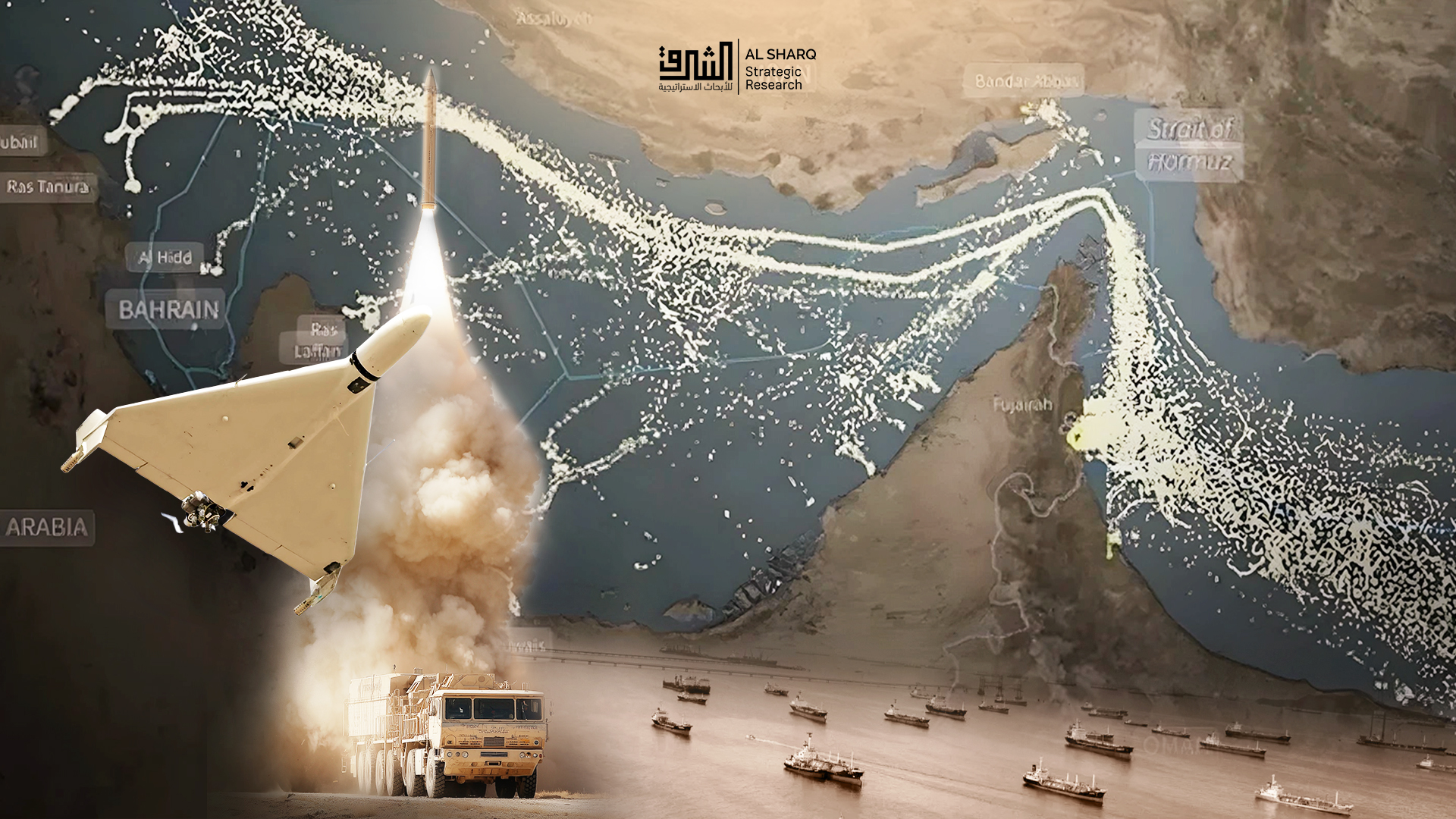
At the same time, Iran moved to control the Strait of Hormuz during this war—unlike in the 12-day war—demonstrating that Tehran assessed the conflict as existential in nature.
From Iran’s perspective, the continued closure of the Strait of Hormuz could shift the regional balance of power in its favor. At the same time, countries highly dependent on Gulf energy supplies would be compelled to recalibrate their geopolitical considerations toward Iran.
Accordingly, Tehran believes that the continuation of the war and the expansion of security uncertainty in the region could strengthen its geopolitical role. In periods of crisis, control over strategic chokepoints and regional deterrence capabilities becomes more prominent. As a result, Iran could leverage its geographical position and strategic capacities to enhance its bargaining power in both regional and international equations.
Based on this view, if regional instability persists and the scenario of restrictions—or the credible threat of restrictions—on the Strait of Hormuz becomes more serious, a new balance of power could gradually emerge in which Iran’s geopolitical weight increases compared with the past. Such developments could influence the behavior of regional and extra-regional actors and push them toward more cautious engagement with Tehran.
The logic behind Iran’s response to the U.S. and Israeli attacks in the February war was shaped by both regional and domestic variables. Prior to the war, nationwide protests had erupted in Iran in January.
Following these protests, the United States increased its military presence in the region and expressed support for the demonstrators. In an unprecedented statement, U.S. President Donald Trump declared that if the Iranian government cracked down on protesters, the United States would attack Iran.
As a result, the Iranian government perceived a degree of alignment between U.S. and Israeli military attacks and their support for protests aimed at overthrowing the political system.
Accordingly, the Iranian leadership feared that additional protests could erupt during the February war with the objective of toppling the political system and with backing from the United States and Israel. It therefore assessed such a possibility as an existential threat and explicitly declared that any new protests would be met with harsher measures than those employed during the January demonstrations.
Meanwhile, both the United States and Israel explicitly called on the Iranian population to seize their political future during the war through protests and to overthrow the Islamic Republic. Israeli Prime Minister Benjamin Netanyahu repeatedly stated during the war that the conflict could create the conditions for such protests.
Concerns about renewed protests following the February war were also linked to regional dynamics and the weakening of Iran’s proxy forces. Following developments after October 7, 2023, and the weakening of Tehran’s non-state allies in the region, Iran’s traditional deterrence model—often referred to as “forward defense”—was significantly eroded.
Consequently, even prior to the February war, Iran had framed any attack as an “existential war” aimed at regime change. In response to discussions in Washington about the possibility of a limited conflict before the war began, Iran declared that any war would be met with a large-scale response.
In this context, prior to the 2026 February war, Iran raised the prospect of “regionalizing the conflict” as a deterrent in the event of U.S. or Israeli attacks.
Before the war began, Iran’s supreme leader, Ayatollah Ai Khamenei for the first time openly warned that the conflict could spread across the entire region, stating: “Americans must know that if they start a war this time, it will be a regional war.”
In essence, the “regionalization of the war” or “horizontal escalation” constituted one of Iran’s pre-war deterrent threats in response to the erosion of its traditional deterrence posture. Iran’s vast geography and geopolitical significance made such an approach feasible.
The weakening of Iran’s deterrence—stemming from the degradation of its proxy forces and the attrition of its military capabilities during the June 2025 twelve-day war—led Tehran to increase the costs of conflict for its adversaries by operationalizing a regional war framework. As part of this approach, Iran also effectively closed the Strait of Hormuz.
From Iran’s perspective, regionalizing the war represents a strategic response to an adversary possessing superior airpower, advanced military technology, substantial firepower, satellite superiority, and the integration of artificial intelligence into military operations.
Iran’s geopolitical advantages have therefore enabled the implementation of a new defense strategy centered on deterrence through the geographic expansion of the conflict.
Under this strategy, Iran has targeted vulnerable U.S. military and economic assets across the Gulf using short-range missiles and armed drones while simultaneously exerting control over the transit of roughly 20 percent of global energy supplies through the Strait of Hormuz.
The existential nature of the war from Iran’s perspective—given the perceived threat to the regime’s survival—also prompted the remaining proxy forces to enter the conflict. In this context, Hezbollah in Lebanon and the Houthis in Yemen became directly involved.
This contrasted with the twelve-day war, during which Iran exercised relative control over escalation and refrained from fully mobilizing these forces—or they may not have complied with Tehran’s preferences.
Furthermore, Iran viewed the February war as an attempt to fragment the country. Even prior to the conflict, Iranian officials had repeatedly argued that the United States and Israel sought to destabilize and ultimately partition Iran.
Strengthening this perception, Donald Trump explicitly stated that the map of Iran after the war might look different from before—an implication widely interpreted in Iran as a reference to potential territorial fragmentation.
At present, the war has entered a more dangerous phase, with Trump threatening to strike Iran’s power generation infrastructure. In response, Iran has announced that it will shift the conflict from a defensive posture to an offensive phase.
Within this new approach, Iran is no longer content merely to absorb pressure and respond symmetrically. Instead, it seeks to redefine the rules of engagement by expanding the battlefield, targeting the supporting infrastructure of U.S. and Israeli operations, and linking escalation in one domain to costs imposed in others. The result is an evolving strategy that attempts to transform military asymmetry into strategic leverage—an approach that is more adaptive and integrated, but also broader and potentially more dangerous.
In practical terms, Iran’s wartime planning has involved both horizontal escalation—expanding the geographic scope of the conflict—and vertical escalation—raising the level of confrontation through the selection of targets, tactics, and weapons.
By broadening the target set to include energy infrastructure and economic assets throughout the Gulf, Iran increases pressure on its adversaries while simultaneously intensifying tensions with neighboring states.
The shifting tone of Emirati and Saudi officials suggests that this dynamic could draw them more directly into the conflict.
Based on the trajectory of the war thus far, Iran may assess that the countries targeted by its strikes have little interest in entering a war initiated by the United States and Israel.
However, although Gulf states did not seek this war, there is a growing perception—at least among some of them—that they may ultimately be compelled to treat the conflict as their own.
Given limitations in its munitions stockpiles, Iran will likely attempt to conduct the war in a manner that keeps the region and the Strait of Hormuz persistently insecure. Even limited launches of drones or missiles are sufficient to maintain such instability.
In such circumstances, the conflict becomes costly for the United States. Although Iran’s missile arsenal may be constrained, the country retains significant drone capabilities—assets that are considerably more flexible and far more difficult to neutralize completely. Even a severely weakened Iran could escalate the conflict through these asymmetric systems, particularly in ways that disrupt global markets and maritime shipping.
This scenario would ensure the persistence of regional instability and undermine efforts to stabilize both the region and global markets. From a deterrence standpoint, Tehran seeks to impose substantial costs on the region, the United States, and the global economy in order to deter future Israeli or American attacks.
Accordingly, Iran has maintained a calibrated form of control over the Strait of Hormuz in order to avoid excessive pressure from certain countries while still preserving strategic advantage. From Tehran’s perspective, the continuation of regional conflict combined with the strategic significance of the Strait could gradually shift the balance of power in West Asia in Iran’s favor. This war could therefore exert a profound impact on the security architecture and geopolitical order of the Middle East. However, by treating the war as an opportunity to “change the equation” rather than merely to end hostilities, Tehran has effectively set a broad and somewhat open-ended objective. While this provides strategic direction, it also raises the threshold for what might be considered an acceptable outcome.
With the escalation of threats from the United States to attack Iran’s power plants and Iran’s reciprocal threat to attack power plants in Israel and regional countries, the war could have entered a more dangerous phase of escalation.
That said, Pakistan’s initiative for a two-week ceasefire marks an important step toward de-escalation. Accordingly, Iran will reopen the Strait of Hormuz, and maritime traffic will resume.
In this context, Iran’s 10-point plan has been accepted by US President Donald Trump to create a basis for future negotiations.
The Iranian plan includes ending attacks and moving toward a permanent ceasefire, lifting sanctions on Iran, guaranteeing no future attacks on Iran, and addressing wider regional conflicts in an attempt to protect Tehran’s allies, like the Lebanese Hezbollah.
Trump stated regarding the two-week ceasefire that the United States will work closely with Iran, which has, in his opinion, ‘undergone a very constructive regime change.’ According to Trump, no uranium enrichment will take place in Iran, and the United States, in cooperation with Iran, will extract and destroy all nuclear dust buried deep in the ground. He also stated that they are negotiating, and will continue to negotiate, tariffs and sanctions waivers with Iran. Many of the 15 points [of America’s conditions] have been agreed upon in his opinion.
However, the Iranian side depicts a different picture. According to Iran’s narrative, it is the United States that has accepted Iran’s 10-point conditions.
It appears that the five main minefields facing the two-week ceasefire are: 1) Iran’s nuclear and missile program, 2) control of the Strait of Hormuz and transit fees, 3) lifting sanctions (the sequence of concessions), 4) Iran’s non-state allies in the region, 5) the regional security architecture and the US military presence.
Accordingly, although a temporary ceasefire has been accepted through Pakistan’s initiative, this ceasefire does not end the war and is contingent on ongoing negotiations between Iran and the United States. On the other hand, according to different reports, China has played a role in Iran’s acceptance of the ceasefire, and this role could continue in subsequent stages.
Despite this, the weakening factors of this ceasefire include deep mutual mistrust, Israeli opposition, disagreements over the nuclear and missile programs, proxy groups, and domestic political pressures in both countries. With this kept in mind, both sides’ need for economic relief, global pressure to reopen the Strait of Hormuz, and the role of mediators (Pakistan, Egypt, and Türkiye) are among the factors influencing this ceasefire.
In general, the current ceasefire is a temporary tactical pause, not the end of the war. Its continuation very much depends on mutual concessions in the negotiations over the next two weeks.